


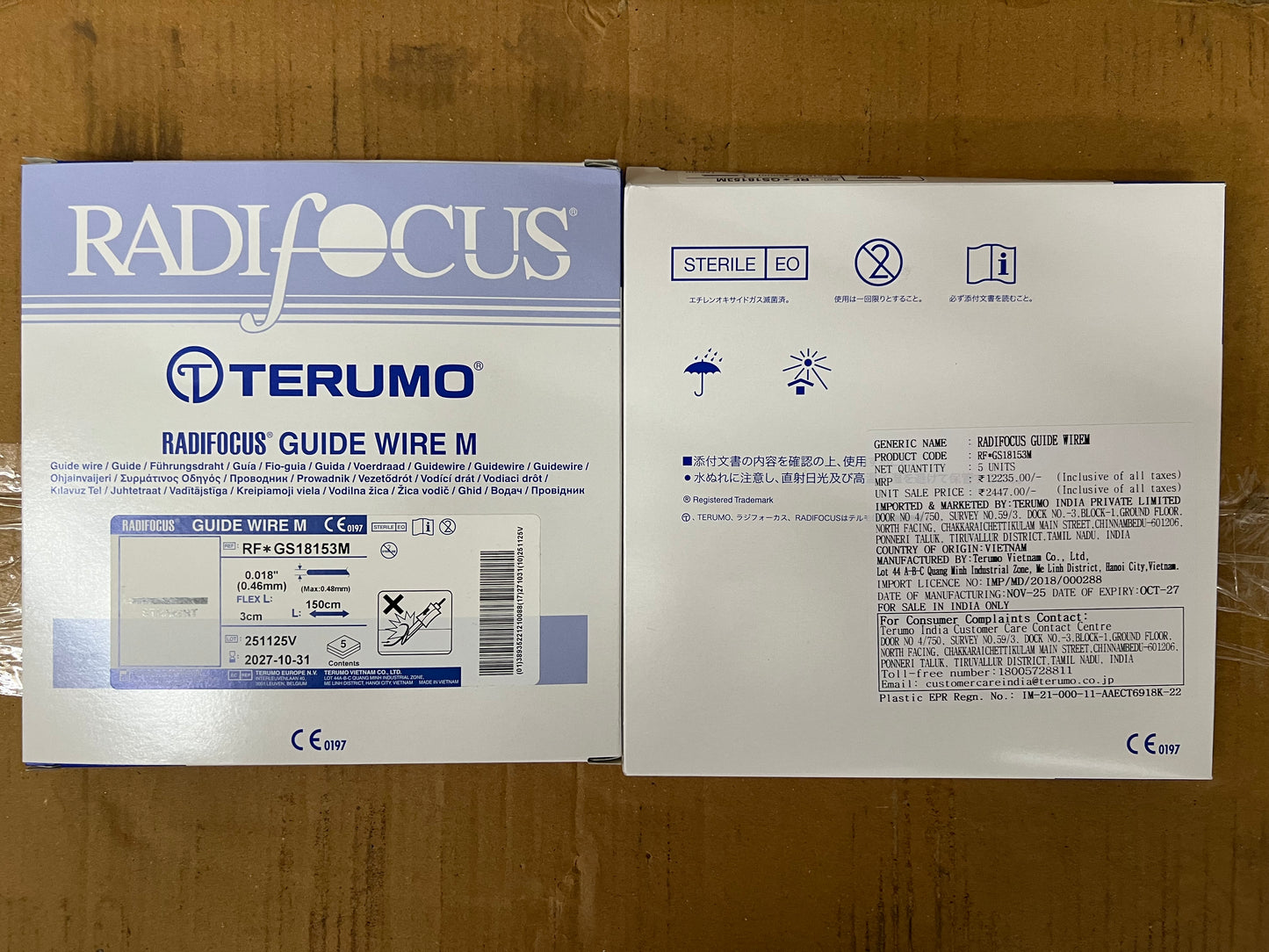
Terumo Radifocus Guide Wire RF*GS18153M, 0.018" × 150 cm, Straight Tip
Terumo Radifocus Guide Wire RF*GS18153M, 0.018" × 150 cm, Straight Tip
The Terumo Radifocus Guide Wire M is a hydrophilic nitinol guidewire used during minimally invasive vascular and interventional procedures to navigate catheter systems through blood vessels to the target anatomy. The guidewire is inserted first — passed through an introducer sheath or catheter — and acts as a rail over which diagnostic catheters, balloon catheters, stent delivery systems, and other interventional devices are then tracked to the intended treatment site.
The RF*GS18153M is the 0.018" variant of the Radifocus M Standard Type. At 0.018" (0.46 mm) outer diameter, it is a micro-guidewire specifically suited to fine-calibre catheter systems used in peripheral vascular interventions, infra-popliteal (below-the-knee) arterial work, renal and visceral artery access, and coronary procedures — where smaller guide wire diameters are required to match the working channel of the catheter or microcatheter being used.
The straight tip design (GS = guidewire, straight) means the distal 3 cm of the wire has no pre-formed curve. In vascular access, straight-tip guidewires are used when the operator intends to manually shape the tip before insertion, when passing through a straight or gently curving access path, or when navigating with the support of a shaped catheter positioned at the target vessel ostium. They are the standard choice for forward-tracking through vessels that do not require significant tip angulation for initial cannulation
Supplied across India by Shah Trading Corporation, Mumbai — trusted distributor and supplier of Terumo interventional and vascular access products.
![]() Key Features
Key Features
Mcoat Hydrophilic Polymer Coating - The entire wire surface — from proximal shaft to the rounded tip — is coated with Terumo's proprietary Mcoat hydrophilic polymer. When activated by moisture, this coating transitions from a dry, handleable state to a near-frictionless lubricious surface. This dramatically reduces the force required to advance the wire through tortuous, calcified, or heavily diseased vessel segments.
Superelastic Nitinol Core - Nitinol (nickel-titanium alloy) has a unique property called superelasticity — it can be bent to very tight radii and returns to its original shape without permanent deformation. This prevents the wire from kinking when navigating acute vessel angles, and allows device exchange without the wire losing its shape during the procedure.
Tungsten-Loaded Radiopaque Polyurethane Jacket - Tungsten is a dense, radiopaque metal. By loading it into the polyurethane jacket surrounding the nitinol core, Terumo makes the entire wire shaft visible under fluoroscopy — not just the tip. The operator can track the full position of the wire in real time during navigation, confirming the wire path through bifurcations and preventing unrecognised wire kinking inside the vessel.
One-to-One Torque Transmission - The one-piece construction and nitinol core deliver direct torque response — when the operator turns the proximal end 90°, the distal tip turns 90°. This 1:1 torque fidelity allows confident directional steering in bifurcations and ostia, particularly important when using a straight-tip wire that depends on precise rotation to select the target vessel.
Rounded Atraumatic Distal Tip - The wire terminates in a rounded, smooth tip — not a point. This distributes the contact force across a larger surface area when the wire meets a vessel wall, reducing the risk of intimal puncture, dissection, or perforation. It is particularly important in 0.018" wires where the small diameter concentrates force at the tip in fragile or diseased vessel segments.
Technical Specifications
| Parameter | Specification |
|---|---|
| Reference Number | RF*GS18153M |
| Outer Diameter | 0.018" (0.46 mm nominal) |
| Total Length | 150 cm |
| Distal Flexible Tip Length | 3 cm (30 mm) — Standard tip length |
| Distal Tip Shape | Straight (no pre-formed curve) |
| Distal Tip End | Rounded, atraumatic |
| Core Material | Nitinol (nickel-titanium alloy) — superelastic |
| Radiopaque Jacket | Polyurethane loaded with tungsten — full-length fluoroscopic visibility |
| Surface Coating | Mcoat™ hydrophilic polymer — full-length, activated by moisture |
| Wire Type | Standard Type (vascular) — denoted by * in reference code |
| Construction | One-piece — no joints; 1:1 torque transmission |
| Sterility | Sterile — single use only |
| Latex Content | Latex-free |
| Units per Box | 5 guidewires |
| Manufacturer | Terumo Corporation — Japan |
| Storage | Cool, dry place; keep sealed until point of use |


Frequently Asked Questions
Why is the 0.018" wire used instead of the standard 0.035" in certain procedures?
The working channel of interventional catheters, balloons, and stent delivery systems is matched to the guidewire diameter the system is designed to track over. Below-the-knee tibial and peroneal arteries — which are 2–3 mm in diameter in many patients with critical limb ischaemia — require microcatheters and micro-balloon systems with small working channels that accept 0.018" wires and cannot accommodate the bulkier 0.035" wire. Similarly, many modern radial-access coronary systems, microcatheters for cerebrovascular work, and some renal artery systems use 0.018" compatible architecture. Using a 0.035" wire in a 0.018" system is not possible — the diameter is too large to enter the catheter lumen. The 0.018" Radifocus M is specifically required for these smaller-bore applications.
How do we order the RF*GS18153M and other Radifocus M variants in India through Shah Trading Corporation?
Shah Trading Corporation, Mumbai, is a trusted distributor and supplier of Terumo interventional products across India, including the full Radifocus Guide Wire M range — vascular Standard, Half Stiff, and Stiff types, across all diameters (0.018" to 0.038"), lengths (80 cm to 450 cm), and tip configurations (straight, angled, J-shapes). Contact our team for pricing, current stock, bulk purchase terms, and institutional supply agreements. Please specify the full reference number (e.g. RF*GS18153M) precisely on purchase orders to ensure the correct diameter, length, tip type, and product variant are supplied. All products are genuine Terumo items with full regulatory documentation.
When would we choose the straight-tip RF*GS18153M over the angled-tip RF*GA18153M?
Straight-tip guidewires are the default choice when the wire can be advanced through the vessel by tracking forward without needing to select (steer into) a branch vessel or sharp angulation. They are used when: the introducer sheath or guide catheter is already pointed at the target vessel; the wire simply needs to advance distally through a relatively straight segment; or the operator prefers to manually shape the wire tip themselves before insertion. Angled-tip wires are preferred when the wire needs to be rotated to point the tip into a specific branch, when navigating acutely angled vessel origins, or in tortuous iliac or renal anatomy where a tip curve helps the wire follow the natural curvature of the vessel. Many experienced interventionalists carry both types and select based on the specific vessel anatomy encountered during the case.
