


Frequently Asked Questions
Why do we need replacement inner cannulae when two are already supplied with the tracheostomy tube kit?
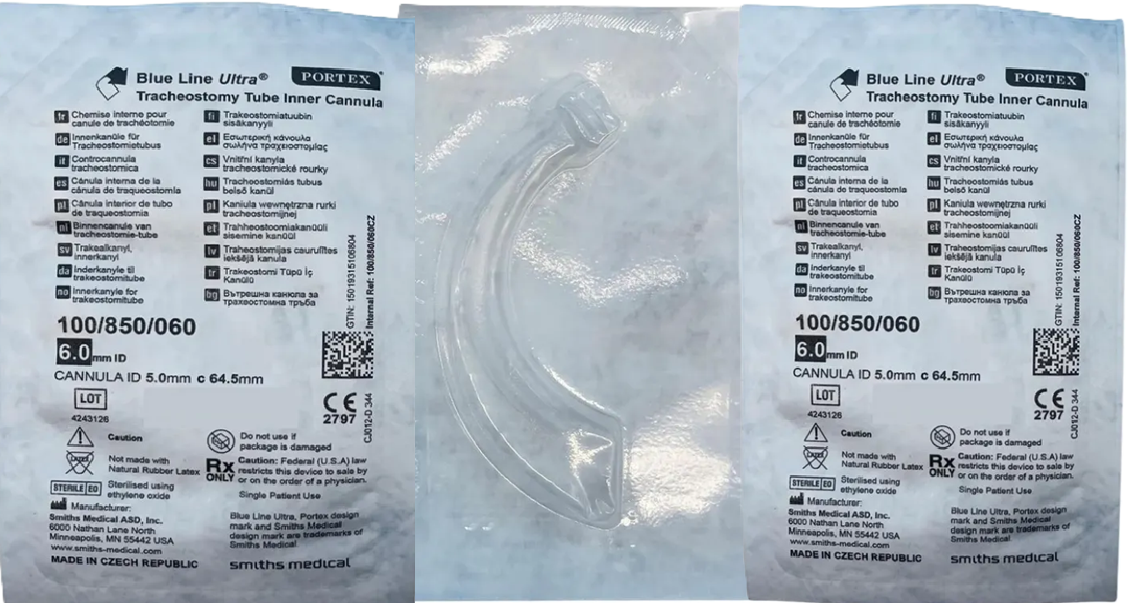
The two inner cannulae included in every Blue Line Ultra kit are intended to support the rotation system — one in, one clean — during the initial period after insertion. In practice, an inner cannula can become permanently blocked with dried secretions beyond effective cleaning, cracked during removal, lost, or damaged during a clinical emergency. For patients on long-term tracheostomies (days to weeks in ICU, or months in home care), the original pair quickly needs supplementing. The 100/850 replacement pack ensures the bedside team always has a clean, genuine spare — avoiding the risk of prolonged use of a compromised or incompletely cleaned cannula.
Our patient is on a ventilator. Is the plain 100/850 the correct inner cannula, or should we use the fenestrated 100/851?
For any patient who is being mechanically ventilated, on CPAP, or who requires a fully sealed tracheal airway, the plain 100/850 is always the correct choice. The fenestrated 100/851 has openings in its wall — intentional for phonation and weaning — but these openings mean it cannot maintain a sealed airway circuit under positive pressure ventilation. Using a fenestrated inner cannula in a ventilated patient causes gas to leak out through the fenestrations rather than reaching the lungs, which is both ineffective and dangerous. The 100/851 is only appropriate when the patient is breathing independently and the clinical team has specifically prescribed fenestrated inner cannula use as part of a weaning or voice therapy plan.
A nurse accidentally used a 7.5 mm inner cannula (100/850/075) in a patient with a 7.0 mm outer tube. Is this dangerous?
Yes — this is a serious size mismatch and a potential patient safety incident. A larger inner cannula forced into a smaller outer tube will not seat correctly, will not click-lock properly, and may not be removable without significant force — particularly critical in an emergency when rapid decannulation or inner cannula removal is required. If a mismatch is suspected, the inner cannula must be removed immediately, the correct size confirmed from the outer tube flange markings, and the correct replacement inserted. All staff involved in tracheostomy care should be trained to verify size matching before every inner cannula insertion. Colour-coded packaging and size markings on each cannula are provided specifically to prevent this error.
